Perimeter seal
Land width, adhesive selection and edge geometry influence the continuous sealing path.
Environmental interface design
A sealed membrane switch uses a coordinated overlay, perimeter adhesive, spacer and tail-exit design to reduce environmental ingress. The switch and enclosure must be evaluated as one interface; a component cannot claim an enclosure IP rating by itself without defined testing.
Engineering variables
Land width, adhesive selection and edge geometry influence the continuous sealing path.
The circuit tail transition is reviewed to avoid creating a weak point in the seal.
Dome movement and pressure equalisation may require controlled venting away from exposure.
Cleaning agents, oils, UV and temperature affect overlay and adhesive selection.
Decision matrix
‘Waterproof’ is not one test condition. Separate routine cleaning, directed water exposure and outdoor moisture, then define the mounted assembly, exposure direction and acceptance evidence. These planning categories are not protection ratings.
| Decision factor | Routine cleaning | Directed water exposure | Outdoor moisture |
|---|---|---|---|
| Exposure input | Name each cleaner, concentration, application method, contact or rinse condition and use frequency. | Define where water comes from, which surfaces it reaches, the exposure sequence and the condition required afterward. | Describe rain direction, condensation, sunlight, temperature change, drainage and any place where water can collect. |
| Assembly boundary | Review the overlay face, printed windows, exposed edges, cut-outs and adhesive bond to the real housing surface. | Include the mounted panel, enclosure land, windows, gasket path, fasteners, seams and other exposed openings. | Map the front panel, housing joints, vents, cable entries and drainage path as one environmental boundary. |
| Tail and connector | Keep the tail exit and connector away from the cleaning path or identify the protection provided by the equipment. | Show how the tail crosses the sealed zone and how the slot, bend support, strain relief and connector area are protected. | Route the tail and connector so trapped or flowing water does not gain an uncontrolled path toward the electronics. |
| Bonding surface | Identify substrate, coating, texture, cleaning and assembly preparation before selecting the mounting adhesive. | Confirm the supported sealing land, surface condition, panel fit and installation process on a representative enclosure. | Review substrate and coating changes, thermal movement, edge support and installation controls across the intended environment. |
| Approval evidence | Inspect graphics, windows, edges, adhesion, key feel and electrical function after the agreed cleaning sequence. | Test the agreed assembled configuration and record the drawing revision, exposure method, acceptance criteria and post-test inspection. | Use a project-specific environmental sequence and inspect drainage, moisture paths, adhesion, appearance and electrical function afterward. |
Record the standard or customer method, edition, mounted configuration, preconditioning, exposure, pass/fail criteria and post-test inspection. A material result or loose-switch test does not prove the protection of the finished enclosure.
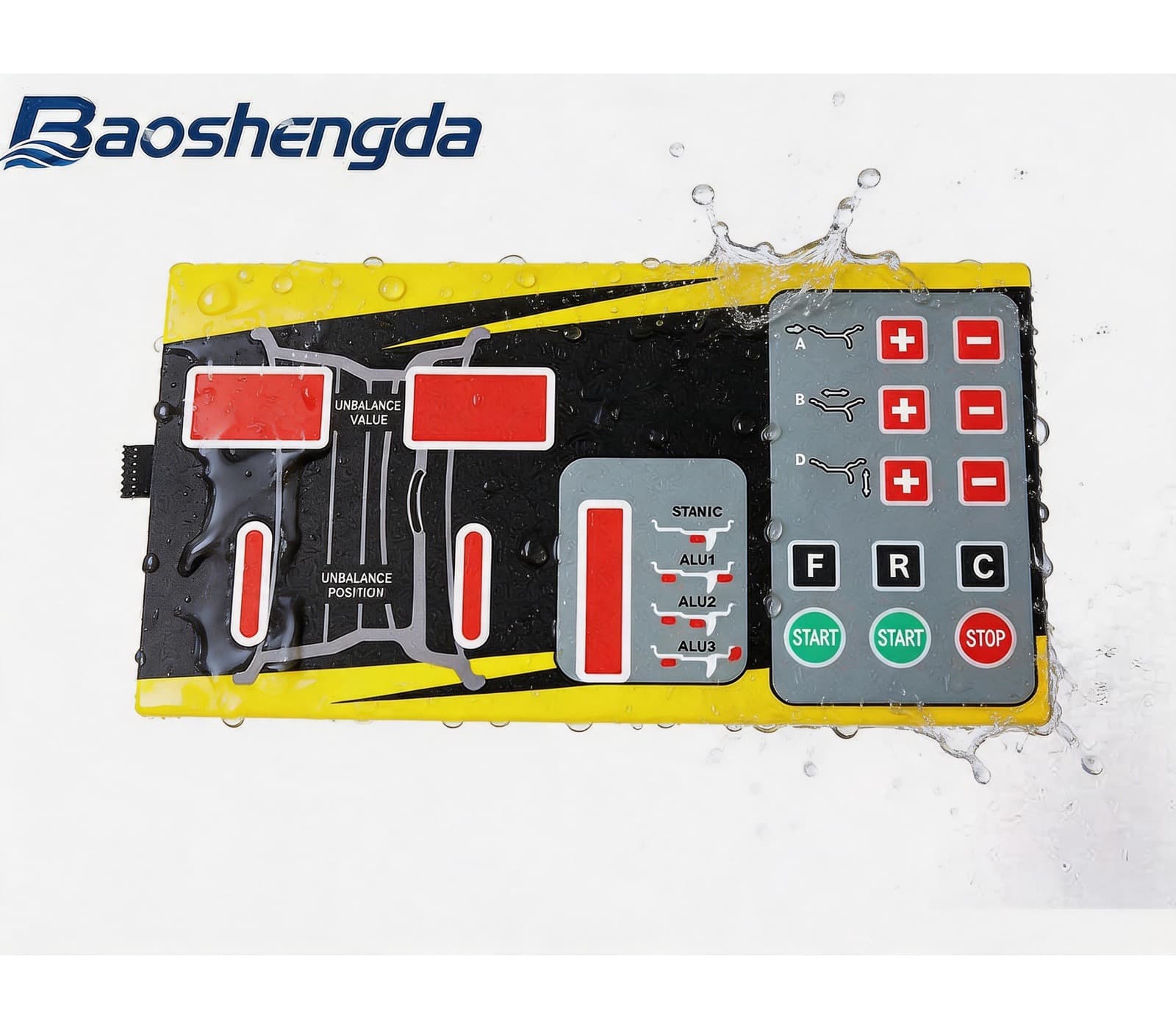
Parent-company product reference
Parent-company product resource provided by Shenzhen Baoshengda Technology Co., Ltd., the parent company of HYR FLEX. The water styling illustrates a possible exposure scenario; it is not an IP test result or a verified enclosure rating.
Representative product resource · project construction is confirmed from the approved drawing.Before the RFQ
Start with the evidence you have now. Open items stay visible for engineering follow-up instead of becoming silent quotation assumptions.
The target code is useful context, but it does not define the switch-to-enclosure boundary. Send the enclosure section, mounting land, openings, tail and connector route, assembly process, test method and acceptance criteria; otherwise the sealing construction and quotation remain conditional.
Name the cleaner or disinfectant, concentration, application and rinse method, contact condition, frequency, temperature context and the appearance, adhesion and electrical checks expected after exposure.
Mount it on a production-representative housing and confirm the perimeter bond, windows, edges, tail exit and connector protection. Run the agreed exposure, then record electrical function, key operation, appearance, adhesion and any observed moisture path against the controlled revision.
A useful fit when
Limits to resolve
Prepare the RFQ
You can submit what is available now. Unknown items remain visible for human follow-up rather than being guessed.
Target environment and exposure
Enclosure material and sealing land
Tail route and cable exit
Required customer validation or test method
Evidence boundary
HYR FLEX describes design inputs, not a universal IP rating. Any rating displayed for a project requires matching test evidence and the correct tested assembly.
Technical reference basis
These publisher resources support the decision framework. They do not prove that HYR uses a named grade, holds a listed certification or has approved a project construction.
Reference context for enclosure protection classifications; no project compliance or HYR certification is implied.
Reference context for defining chemical, concentration, exposure and reported changes; no project compliance is implied.
Supplier context for membrane-switch spacer and adhesive families; no named 3M grade is approved or promised for a project.